
THE UNFINISHED UNION
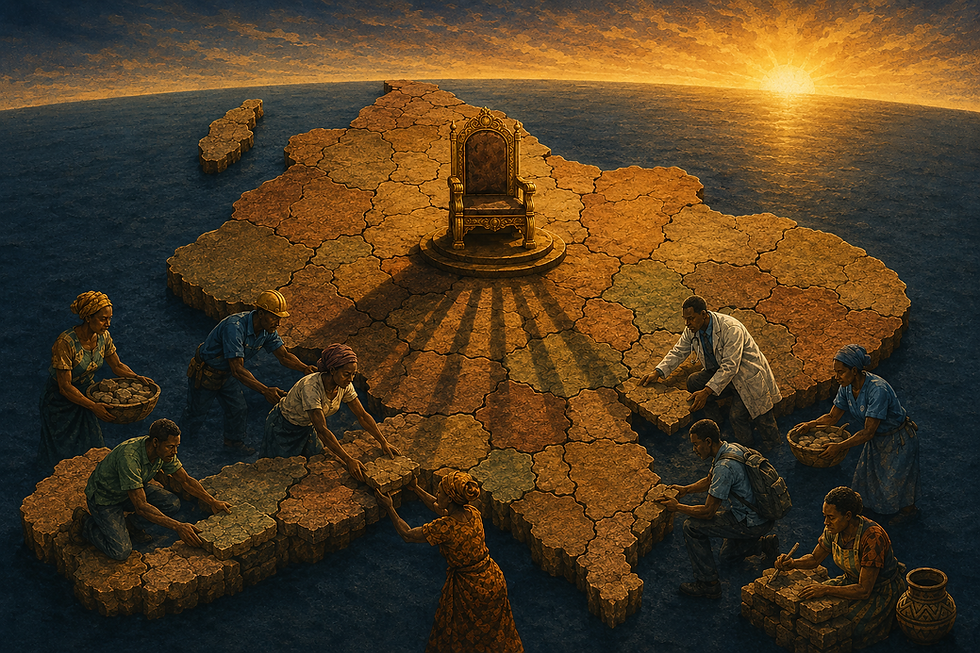
Africa Must Choose Strong Institutions Over Strongmen. Our continent does not lack resources, talent or vision. It lacks public power disciplined by accountability, integration and service. The next phase of African liberation must therefore be institutional, economic and civic.
There is a chair in every seat of government that is larger than the person who occupies it.
It may be called the presidency, the premiership, the throne, the cabinet or parliament. Whatever its name, that chair is not a private possession. It is borrowed from the people. It is paid for by the people. And one day, peacefully and constitutionally, it must be returned to the people.
Yet across too much of our continent, public office is treated as private property. A title meant to describe a duty becomes a shield against scrutiny. A motorcade becomes proof of importance. The national treasury becomes a political survival fund. Loyalty to the office-holder is rewarded above loyalty to the constitution. Elections become rituals of endorsement instead of instruments of choice.
This is the central warning of Africa’s unfinished union: when leaders love the chair more than the people, the whole continent pays.
It pays in hospitals without medicines, classrooms without books, farms without roads, mines without local industry, graduates without work and communities without confidence in tomorrow. It pays when a young African believes that the only road to dignity begins at an airport or on a dangerous sea route. It pays whenever a resource-rich nation exports its wealth in raw form and imports unemployment in return.
This is not an argument against leadership. Africa needs courageous, competent leaders. Nor is it an argument that every government has failed, every foreign partner is an enemy, or every African state faces the same conditions. Our continent is too large and diverse for such lazy conclusions. It is an argument against a political culture that makes individuals stronger than institutions and leaves citizens weaker than both.
The ultimate question is simple: Does power serve the people, or do the people serve power?
Independence Was a Beginning, Not a Finished Job
Political independence changed the course of history. It restored flags, parliaments, citizenship and self-rule to peoples who had been conquered, divided and exploited. We must never minimise that victory or the sacrifices that made it possible.
But independence did not automatically dismantle every system built during colonial rule. The Berlin Conference of 1884–85 did not draw every modern African border in a single meeting, as popular memory sometimes suggests. What it did was accelerate and legitimise the partition of Africa among European powers without African consent. The colonial order then imposed boundaries, economies and administrative systems designed mainly for control and extraction.
Many railways ran from a mine or plantation to a port, not from one African market to another. Education systems often prepared a small clerical class to serve the administration rather than a mass of engineers, scientists, industrialists and innovators. Raw materials travelled outward; finished goods returned at a premium. Neighbouring communities were separated by borders they had not chosen, while distant capitals decided their fate.
That history still casts a long shadow. But history must be used as a source of truth, not as an excuse for permanent failure.
External power continues to shape African choices through unequal bargaining power, debt pressure, tax avoidance, commodity markets, security interests and control over technology and finance. Those realities must be confronted honestly. At the same time, no foreign actor can sign away a nation’s resources without an African signature somewhere on the agreement. No tax concession, opaque loan or sweetheart mining contract becomes public policy without domestic authority. No constitution edits itself to extend a ruler’s tenure.
The uncomfortable truth is that Africa’s vulnerability is sustained by both external pressure and internal complicity. Blaming only outsiders robs Africans of agency. Blaming only Africans erases the architecture of historical and continuing inequality. Maturity requires us to hold both truths at once.
The next liberation struggle is therefore not simply about who occupies the state. It is about how the state works, whom it serves and whether its rules are stronger than the ambitions of any one person.
Raw Wealth, Exported Opportunity
Africa’s tragedy is not that it lacks wealth. It is that too little of the wealth created from African land, labour and knowledge remains in African communities.
Consider the familiar journey of a mineral. It is dug from African soil, transported to a port and exported in raw or lightly processed form. Elsewhere, it is refined, engineered into components, branded, financed and sold at many times its original value. Africa earns at the lowest-value end of the chain and then buys back the finished product at the highest-value end.
The same pattern appears in agriculture. Cocoa, coffee, cotton, cashews and other crops can leave the continent with limited processing, while the lucrative work of manufacturing, packaging, marketing and retailing takes place elsewhere. The farmer carries the climate risk. The foreign brand captures the margin.
UN Trade and Development has repeatedly warned that most African economies remain dependent on commodities. Commodity exports can bring essential revenue, but dependence makes countries vulnerable to price shocks and weakens the creation of stable, skilled employment. A mine can raise national output without transforming the town beside it. An oil field can enrich a budget while households remain without reliable electricity.
The answer is not isolation from the world. Africa needs trade, investment, capital, technology and partners. The answer is to negotiate those relationships from a position of competence and collective strength. Every major resource agreement should answer clear public questions: What will be processed locally? How many skills will be transferred? Which local suppliers will participate? What environmental obligations will be enforced? Who are the beneficial owners? What tax is actually paid? What happens when the resource is exhausted?
Development is not measured by how quickly raw wealth leaves the port. It is measured by how much knowledge, industry, revenue and opportunity remain after it leaves.
The Money That Leaves in Silence
Some of Africa’s greatest losses do not appear in dramatic headlines. They leave quietly through manipulated invoices, abusive transfer pricing, profit shifting, tax evasion, corruption and criminal networks.
UN Trade and Development has estimated that Africa loses about US$88.6 billion every year through illicit financial flows. The exact total is difficult to calculate precisely, but the scale of the warning is impossible to ignore. That is money that could help finance schools, public health, energy systems, climate resilience, transport links and local enterprise.
This leakage has many accomplices. Some are public officials who trade national interest for personal benefit. Some are corporations that exploit regulatory gaps. Some are professional intermediaries who create layers of secrecy. Some are financial centres outside Africa that receive wealth without asking enough questions about its origin.
Stopping the loss therefore requires action on both sides of the transaction. African governments must publish major contracts, establish credible registers of beneficial ownership, strengthen revenue authorities, protect whistle-blowers, digitise customs systems and give parliaments real oversight of public borrowing. International partners must end the secrecy and tax practices that make stolen or untaxed wealth easy to hide.
Corruption is not an African identity. It is a crime of opportunity that thrives wherever institutions are weak, secrecy is profitable and consequences are selective. The proper response is not shame; it is enforcement.
When Office Becomes an Inheritance
The strongest nation is not the one with the strongest ruler. It is the one whose courts can rule against the government, whose journalists can investigate the powerful, whose parliament can scrutinise the budget, whose election authority can resist intimidation and whose civil service can function when presidents change.
Africa’s citizens understand this more clearly than they are sometimes given credit for. In Afrobarometer’s 2024 flagship findings across 39 countries, two-thirds of respondents said they preferred democracy to any other form of government. Eight in ten rejected one-person rule. The public appetite for accountable government remains strong even where disappointment with political performance is deep.
That distinction matters. Citizens are not abandoning democracy because they love dictatorship. Many are frustrated because the democratic promise has too often been reduced to election day. A ballot without responsive institutions, honest administration, personal security and economic possibility soon feels hollow.
The African Charter on Democracy, Elections and Governance already sets out the continental standard: constitutional order, credible elections, human rights and rejection of unconstitutional changes of government. The weakness is not the absence of principles. It is inconsistent enforcement.
Constitutions must not become notebooks in which incumbents erase the rules that inconvenience them. Term limits should not depend on who is in power. Security forces must protect the constitutional order, not a political personality. Opposition parties must be free to organise. Public broadcasters must serve the public. Electoral disputes must be decided by independent institutions, not by violence in the streets.
A leader who leaves office according to the law does not become smaller. That leader proves that the nation is larger.
The Practical Cost of a Divided Continent
Pan-Africanism is often celebrated in speeches, summits and anniversaries. But unity that exists only in language is ceremonial, not transformational.
The African Union’s 2025 assessment of continental integration acknowledged progress while warning that implementation still lags behind ambition. Intra-African trade remains at roughly 16–18 per cent of total African trade. Free-movement commitments remain under-ratified. Industrialisation and value addition are still at an early stage.
These are not abstract diplomatic failures. They affect the price of food, the cost of doing business and the availability of jobs. A small manufacturer may find it easier to import from another continent than to sell across an African border. A traveller may cross Europe with one visa but face multiple applications to visit neighbouring African countries. Trucks wait at congested borders while perishable goods spoil. Airlines often route African passengers through distant hubs because direct connections are limited or expensive. Different standards and payment systems turn a nearby market into a foreign obstacle.
The African Continental Free Trade Area is therefore more than a trade agreement. If implemented seriously, it can become an industrial strategy. A larger common market gives African firms the scale to manufacture medicines, process food, build machinery, expand digital services and develop regional supply chains. A component made in one country can feed a factory in another and reach consumers across the continent.
But signatures are not implementation. Tariffs must come down according to agreed schedules. Customs systems must speak to one another. Roads, rail, ports, energy pools and digital networks must connect. Small businesses—especially those owned by women and young people—need finance and reliable information. Workers need protections so that integration does not become a race to the bottom.
Unity does not require Africa’s many nations, languages and cultures to disappear. It requires us to turn diversity into coordinated strength. One continent can contain many flags and still build common infrastructure, defend shared interests, move people more freely and negotiate globally with a stronger voice.
Reparations—and Responsibility
The demand for reparatory justice is legitimate. Slavery, colonial dispossession, racial violence and extractive rule created enormous losses whose consequences did not vanish at independence. The African Union made reparations its theme for 2025 and has supported a Decade on Reparations from 2026 to 2036. That is an important step from memory toward policy.
Reparations should be understood broadly. They may include the return of stolen cultural objects and human remains; the opening of archives; institutional and educational repair; recognition and apology; fairer rules in trade, taxation and debt; and material measures proportionate to historic harm. The conversation must be African-led, evidence-based and sustained beyond commemorative events.
Yet reparations and present-day accountability are not competing ideas. Africa can demand justice from former colonial powers while demanding integrity from current African governments. We can challenge unfair global rules while refusing to tolerate theft at home. Colonialism explains much about the structures we inherited; it cannot be used as an alibi for every budget diverted, every election manipulated or every public institution deliberately weakened today.
Historical justice without responsible government will not free us. Responsible government without historical justice will leave the old imbalance unchallenged. Africa requires both.
A Continental Programme of Seriousness
The distance between the Africa we describe and the Africa we live in will not be closed by another slogan. It requires a programme citizens can measure. Seven commitments would make a decisive beginning.
Power must expire. Defend constitutional term limits, independent election bodies, impartial courts and peaceful transfers of authority. No individual should be allowed to become the state.
Publish the deal. Place major mining, energy, infrastructure and public-debt agreements in the public domain. Disclose beneficial owners, tax terms, guarantees and environmental obligations. Secrecy is the oxygen of bad governance.
Process what we produce. Link incentives to local value addition, supplier development, research and skills transfer. Refine more of what we mine. Manufacture more from what we grow. Build African brands with global ambition.
Make African integration visible in daily life. Implement the free-trade area, modernise border posts, reduce visa barriers, connect transport and energy networks, harmonise standards and make cross-border payments cheaper.
Invest in human capability. A sovereign continent is built in classrooms, clinics, laboratories, workshops and digital networks. Education must reward problem-solving and creation, not only memorisation. Public health must be treated as productive infrastructure, not charity.
Protect the public’s right to know. Independent media, access-to-information laws, audit institutions, civil society, whistle-blowers and open budgets are not nuisances to government. They are part of the machinery of good government.
Measure leaders by outcomes, not ceremonies. Publish clear national and continental scorecards: jobs created, electricity delivered, contracts disclosed, goods traded within Africa, children learning, maternal deaths prevented and public money recovered. A summit photograph is not a result.
None of these commitments demands that Africa withdraw from the world. They demand that Africa enter the world on firmer ground—with open eyes, stronger institutions and a clearer sense of its own interests.
Citizens Are Not Spectators
It is tempting to speak of “the leaders” as if the rest of society has no role. But a republic is not a theatre in which citizens watch a small cast perform politics. The public is the author of legitimate authority.
Citizens can organise peacefully, vote consistently, attend council meetings, read budgets, support independent journalism, defend honest public servants, join professional bodies and trade unions, use access-to-information laws, challenge unlawful decisions in court and refuse the everyday normalisation of bribery. Communities can form cooperatives, mentor young entrepreneurs, buy locally where quality and price allow, and create cross-border networks of knowledge and solidarity.
None of this is easy. Civic space is restricted in some countries. Journalists, activists and opposition figures can face intimidation. The answer is not reckless confrontation or violence, which usually harms ordinary people first. The answer is disciplined, lawful, persistent civic action supported by regional and continental solidarity.
The defence of democracy cannot wait until an election is already in crisis. Institutions are protected in the daily choices of judges, teachers, police officers, editors, accountants, voters, business leaders and public officials. Every person who refuses an unlawful order strengthens the republic. Every citizen who asks for the receipt, the tender, the audit and the result turns accountability from a slogan into a habit.
A Direct Message to Those Who Govern
To Africa’s presidents, prime ministers, monarchs, ministers, parliamentarians, governors and senior officials: your title is not proof of your greatness. It is a temporary description of your responsibility.
The convoy will one day pass without you. The portraits will come down. The praise-singers will learn another name. What will remain is the condition in which you left the people and the institutions entrusted to you.
Did you leave a court that could act without fear? Did you create work that gave young people a reason to stay and build? Did you turn a mine into an industrial ecosystem, a tax into a school, a public promise into a working clinic? Did you make your country easier to govern after you were gone? Did you bring Africa closer together in practice?
If you did, history may remember your name with gratitude. If you used the state to preserve yourself while the public realm decayed, the title will not save your legacy.
Leadership is not measured by how long one remains in the chair. It is measured by how much stronger the nation stands when one finally rises from it.
The Choice Before History
Africa is not a country, and there is no single African experience. But across our different nations runs a shared aspiration: to live with dignity under governments that respect the law; to turn abundant resources into broad opportunity; to move, trade, learn and create across borders; and to meet the world neither as a beggar nor as a pawn, but as an equal partner.
That aspiration is not naïve. It is already present in the African Union’s Agenda 2063, which imagines an integrated, prosperous and peaceful continent driven by its own citizens. The failure lies not in the vision. It lies in the gap between adoption and action.
We must now close that gap.
Let this be the generation that moves Pan-Africanism from the podium to the border post, from the anthem to the factory floor, from the conference communiqué to the classroom, clinic and courtroom. Let us build states in which power is limited, public money is visible, productive wealth is shared and citizenship is larger than party loyalty.
History will not be impressed by the length of a motorcade. It will ask whether power became bread, books, medicines, electricity, justice, jobs and freedom.
Our continent does not lack resources. It does not lack intelligence. It does not lack imagination. What it has too often lacked is power disciplined by institutions and leadership aligned with the people.
The unfinished union will not be completed by one heroic ruler. It will be completed by millions of citizens and thousands of institutions doing their duty across generations.
Strong institutions, not strongmen. Shared prosperity, not private preservation. One continent, many nations, one future.


Comments